
How Cashback Bonus Works at Rummy 365
Cashback bonus at Rummy 365 is designed as a recovery-based reward system that returns a percentage of losses back to the user over a defined period. Unlike traditional promotions that provide upfront value, cashback operates after gameplay has already occurred. This makes it fundamentally different in both structure and outcome.
Instead of increasing the starting balance, cashback adjusts the result after a session or cycle is completed. The system calculates net losses within a timeframe and returns a portion of that value back into the account. This returned balance can then be reused within the platform, often under specific conditions.
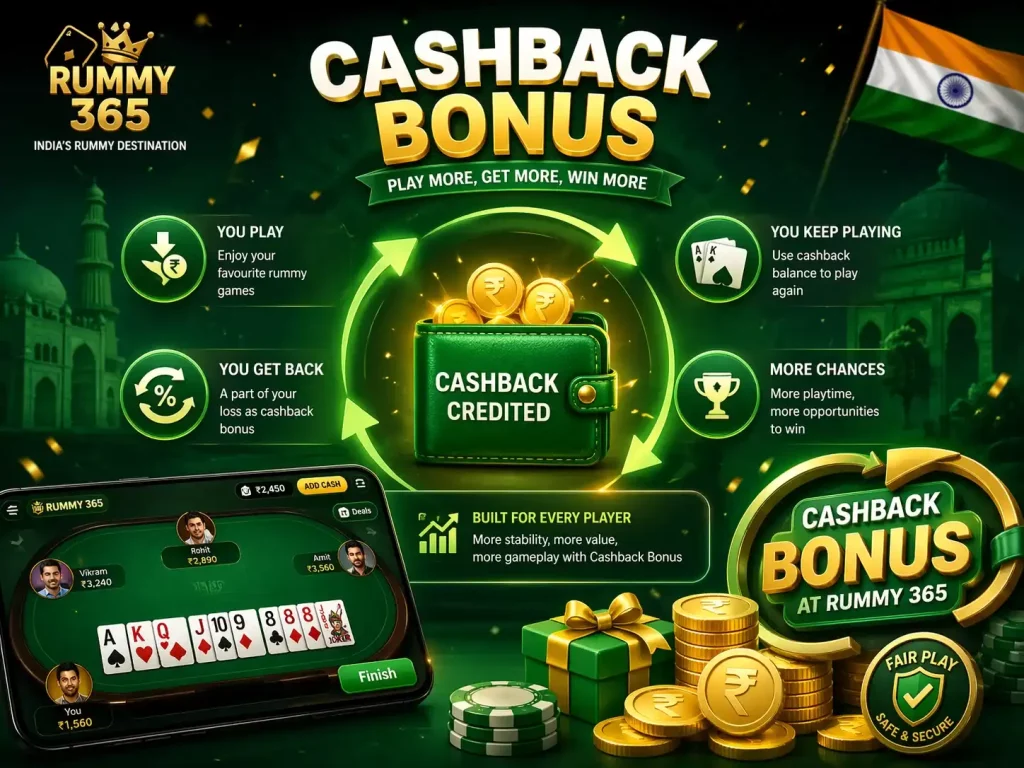
One of the most important aspects of cashback is timing. The reward is usually not instant. It can be distributed daily, weekly, or as part of campaign-based cycles. This delay introduces a structured rhythm where users interact with the platform, complete sessions, and then receive partial recovery afterward.
Another key point is that cashback does not eliminate loss. It reduces it. This means the system is designed to soften variance rather than remove it entirely. Over multiple cycles, this creates a more balanced experience where outcomes become less extreme compared to single-session play.
In many cases, cashback also interacts with other reward systems. It can exist alongside deposit offers, promo campaigns, or even code-based rewards. However, its role remains distinct — it is always tied to past activity rather than future potential.
Cashback Structure and Distribution
| Type | Calculation Period | Typical % | Purpose |
|---|---|---|---|
| Daily Cashback | 24 hours | 5–10% | Short-term recovery |
| Weekly Cashback | 7 days | 10–20% | Balanced recovery |
| Campaign Cashback | Custom | 15–25% | High-value return |
The structure above shows how cashback varies depending on timeframe. Short cycles provide frequent but smaller returns, while longer cycles typically offer higher percentages but require more activity to qualify.
Cashback Outcome Distribution
After reviewing the distribution of cashback outcomes, it becomes clear that recovery is not a guaranteed result but rather a probabilistic adjustment of previous activity. While a portion of losses is returned, the overall balance still depends on how effectively the recovered value is utilized in subsequent sessions.
One important observation is that cashback introduces a delayed feedback loop. Instead of influencing the outcome of a single session, it impacts future sessions by extending available balance. This creates a layered experience where each cycle builds on the previous one, rather than resetting completely.
Another factor to consider is that recovered funds are often subject to additional conditions. Even though cashback appears as returned value, it may still require further interaction before becoming fully usable. This reinforces the idea that recovery is part of a broader system rather than an instant benefit.
Consistency also plays a significant role. Users who engage with cashback cycles regularly tend to see more stable results over time compared to those who interact sporadically. This is because repeated participation aligns better with the system’s calculation periods and reward distribution logic.
It is also worth noting that cashback can influence session pacing. Knowing that a portion of losses may be returned can affect how users approach their activity, often leading to more measured and structured interaction patterns. This indirect effect can be just as important as the returned value itself.
Over multiple cycles, cashback begins to function as a balancing mechanism that smooths out fluctuations. While it does not eliminate variance, it reduces extremes and provides a more gradual progression of results. This makes it particularly relevant in environments where outcomes can vary significantly between sessions.
Finally, cashback should be viewed as part of a continuous system rather than a one-time event. Its true value becomes visible only when observed across several cycles, where recovery, reuse, and progression combine into a more predictable and manageable flow of balance.
Cashback Bonus Value and Efficiency at Rummy 365
Understanding cashback value goes beyond simply looking at the percentage returned. While the headline number may suggest a clear benefit, the real effectiveness depends on how that returned value behaves after it is credited back to the account.
Unlike direct rewards that increase the starting balance, cashback works by extending the lifecycle of existing balance. This means its value is realized gradually, often across multiple sessions rather than within a single cycle. As a result, efficiency becomes the key factor in determining how useful cashback actually is.
What Defines Cashback Efficiency
Efficiency in cashback systems is influenced by several variables working together. The percentage returned is only one part of the equation. Timing, usage patterns, and balance stability all contribute to how much value is retained over time.
For example, a higher cashback percentage may seem more attractive, but if it is tied to longer cycles or stricter conditions, the actual usability may be reduced. On the other hand, smaller but more frequent returns can create a more consistent and predictable flow of value.
Another important dimension of efficiency is how quickly cashback is reintegrated into active balance. Faster cycles tend to increase engagement with the returned value, but they also expose it more frequently to volatility. Slower cycles, in contrast, may reduce immediate interaction but can lead to more measured usage patterns over time.
It is also essential to consider the relationship between cashback and session structure. Short, fragmented sessions may not fully benefit from the returned value, while more structured and consistent sessions allow cashback to play a more meaningful role in extending balance. This difference highlights how efficiency is not only about the reward itself, but also about how it aligns with user behavior.
Another factor is proportional impact. Cashback tends to have a stronger relative effect on smaller balances, where even a modest return can significantly extend activity. In larger balance environments, the same percentage may have less noticeable influence, making its efficiency more dependent on long-term accumulation rather than immediate effect.
In addition, the interaction between cashback and overall balance stability cannot be ignored. When balance fluctuations are extreme, returned value is more likely to be reabsorbed into the system. In more stable conditions, however, cashback has a higher chance of contributing to gradual growth or prolonged sessions.
It is also worth noting that efficiency improves with familiarity. As users gain more experience with cashback cycles, they begin to recognize patterns in timing, value distribution, and retention. This awareness allows for better alignment between usage and system mechanics, which can lead to more consistent outcomes.
Finally, cashback efficiency should be viewed as a balance between immediacy and sustainability. While instant returns may seem more attractive, sustainable value often comes from repeated cycles where recovery and reuse gradually shape the overall result.
Cashback Value by Scenario
| Scenario | Loss Amount | Cashback % | Returned Value |
|---|---|---|---|
| Short Session | 50 | 10% | 5 |
| Medium Session | 150 | 15% | 22.5 |
| Long Session | 300 | 20% | 60 |
The table shows that cashback scales with activity. Larger sessions result in higher absolute returns, but they also involve greater exposure to variance. This means that while the numbers increase, the underlying risk remains.
Balance Flow After Cashback
Once cashback is credited, it becomes part of the active balance. However, this does not guarantee retention. The returned value re-enters the same system of fluctuation, meaning it can either extend gameplay or be lost again depending on outcomes.
This re-entry into the balance cycle is what makes cashback fundamentally different from static rewards. Instead of acting as a fixed gain, it behaves as a flexible extension of available funds, constantly interacting with ongoing activity. The same mechanics that affected the original balance now apply again to the recovered value.
Because of this, the effectiveness of cashback is closely tied to how the balance is managed after it is credited. If the returned funds are used immediately in high-variance situations, they are more likely to be absorbed back into the system. On the other hand, more controlled usage can increase the chances of preserving part of that value over time.
Another important aspect is that cashback often creates additional decision points. After receiving returned funds, the next step is no longer automatic. The user effectively enters a new cycle where the approach to balance usage can influence the final outcome more than the initial recovery itself.
It is also worth noting that cashback contributes to extending session continuity. Instead of ending a session with a full reset, the returned value allows for further interaction without requiring additional input. This continuity plays a key role in shaping longer gameplay sequences and more gradual balance evolution.
Over time, this repeated cycle of loss, recovery, and reuse creates a pattern where outcomes become less dependent on single events and more influenced by overall flow. This is why cashback is often evaluated across multiple sessions rather than isolated moments.
In this context, the balance after cashback should be seen as transitional rather than final. It represents an intermediate stage where value has been partially restored but is still subject to the same conditions and dynamics as before.
Cashback Retention Distribution
After analyzing cashback retention, it becomes clear that returned value does not behave as a fixed gain but rather as a dynamic extension of balance. While a portion of the cashback is retained, a significant share re-enters the gameplay cycle and is exposed to the same fluctuations as the original balance.
This creates a layered effect where cashback operates not as a final outcome, but as an additional stage in the balance lifecycle. Instead of closing a session, it extends it, allowing the recovered value to generate further interaction and potential progression.
Another important observation is that retention is closely tied to how the returned funds are used. Structured and controlled usage tends to preserve more value, while aggressive or high-variance sessions often recycle cashback back into the system. This reinforces the idea that cashback efficiency is not only about the percentage received, but also about post-credit behavior.
It is also worth noting that cashback introduces a form of delayed optimization. Users do not immediately see its full impact, but over several cycles, the cumulative effect becomes more visible. This gradual accumulation of value is what defines its long-term importance within the system.
Finally, cashback retention highlights the balance between recovery and reuse. While not all returned value is preserved, the system still reduces the overall impact of losses and creates a more stable progression over time.
Final Analysis of Cashback Bonus at Rummy 365
Cashback bonus at Rummy 365 functions as a long-term balancing mechanism rather than a one-time reward. Across multiple sessions, it creates a structured flow where losses are partially returned, reintroduced into gameplay, and redistributed through subsequent activity. This cyclical behavior is what defines its overall impact.
Unlike direct rewards that front-load value, cashback spreads value over time. It operates in layers: initial loss, partial recovery, reuse of recovered funds, and eventual outcome. Each layer adds complexity, but also provides additional opportunities for balance extension and progression.
Cashback Lifecycle Overview
To fully understand how cashback behaves, it is useful to look at its complete lifecycle. From initial gameplay to final outcome, each stage contributes to the distribution of value.
| Stage | Process | State | Result |
|---|---|---|---|
| Gameplay | Session activity | Loss | Eligible |
| Calculation | Loss evaluated | Processed | Defined |
| Credit | Funds returned | Playable | Available |
| Reuse | Balance re-entered | Active | New Cycle |
Before moving to the final outcome distribution, it is important to understand that cashback results are not determined at a single point in time. Instead, they emerge gradually through multiple interactions between recovery, reuse, and balance fluctuation.
Each stage shown in the lifecycle contributes to the final result, but none of them guarantees a specific outcome on its own. The recovery phase introduces additional value, the reuse phase redistributes that value back into the system, and the final state depends on how those two stages interact over time.
One key observation is that cashback systems are inherently cyclical. The returned funds do not exit the system immediately; they continue to circulate within it. This creates a feedback loop where each session influences the next, making outcomes dependent on sequences rather than isolated events.
It is also important to recognize that not all recovered value follows the same path. Some portion is retained and contributes to long-term balance growth, while another portion is reabsorbed into gameplay. This division is what ultimately shapes the distribution seen in the final results.
Another factor is timing. The moment at which cashback is credited can affect how effectively it is used. Early reuse may expose it to higher volatility, while delayed or more structured usage can improve retention. This timing dynamic adds another layer to how outcomes are formed.
In addition, the relationship between recovery and reuse highlights the difference between temporary and stable value. Temporary value extends activity but may not persist, while stable value contributes to longer-term progression. The balance between these two determines overall efficiency.
The following distribution illustrates how these dynamics typically resolve after multiple cashback cycles, showing the proportion of value that is retained, reused, or ultimately lost within the system.
Final Outcome Distribution
Final Perspective
Cashback bonus at Rummy 365 is best understood as a continuous system rather than a single reward. It redistributes value over time, reduces volatility, and creates a structured progression across sessions.
Its true strength lies in repetition. While individual cycles may vary, the cumulative effect of recovery, reuse, and redistribution produces a more stable long-term experience.
Rather than focusing on immediate returns, cashback should be evaluated based on how it performs across multiple cycles. This broader perspective provides a more accurate understanding of its real value within the platform.
Another perspective worth considering is how cashback integrates into the overall balance flow rather than existing as a separate reward. Instead of being isolated, it continuously interacts with previous and future sessions, forming a chain of interconnected outcomes. This makes it more dynamic compared to static promotional systems.
One of the defining characteristics of cashback is that it reduces the gap between losing and continuing. Without it, each session would be independent, and results would reset completely. With cashback, however, there is always a partial bridge between sessions, allowing value to carry forward in a controlled way.
It is also important to recognize that cashback creates a smoothing effect over time. While individual sessions may still vary significantly, the overall curve of results becomes less volatile. This does not remove uncertainty, but it makes the progression more gradual and easier to interpret over longer periods.
Another key element is accumulation. Even when individual cashback amounts seem small, their combined effect across multiple cycles can become meaningful. This gradual build-up often goes unnoticed in short-term analysis but becomes more visible when looking at extended activity.
In addition, cashback systems naturally reward consistency. Regular interaction aligns with calculation cycles, making outcomes more predictable compared to irregular usage. Over time, this alignment improves the efficiency of the system without requiring any direct adjustment from the user.
It is also worth noting that cashback introduces a different type of engagement logic. Instead of focusing on maximizing a single outcome, it encourages a more balanced approach where multiple sessions contribute to the final result. This shift in perspective changes how value is perceived and measured.
Finally, cashback should be understood as part of a continuous feedback loop. Each session generates data, that data determines recovery, and the recovery feeds into the next session. This loop creates a structured environment where results are shaped progressively rather than instantly.
When viewed in this context, cashback becomes more than just a percentage return. It functions as a stabilizing mechanism that connects sessions, distributes value over time, and creates a more consistent overall experience within the platform.






Comments