Promotions at Rummy 365: How Ongoing Offers Shape Player Experience
Promotions on Rummy 365 represent a continuous layer of value that extends far beyond the initial welcome stage. While the welcome offer introduces users to the platform, ongoing promotions define how value evolves over time. This makes the Promotions page one of the most important informational sections, especially for users who want to understand how the platform supports regular gameplay.
Unlike one-time offers, promotions are dynamic. They change depending on player activity, timing, and platform structure. Some are predictable and recurring, while others appear for a limited period. This creates a system where value is not fixed, but distributed across different moments of interaction. For players, this means the experience remains varied instead of repetitive.
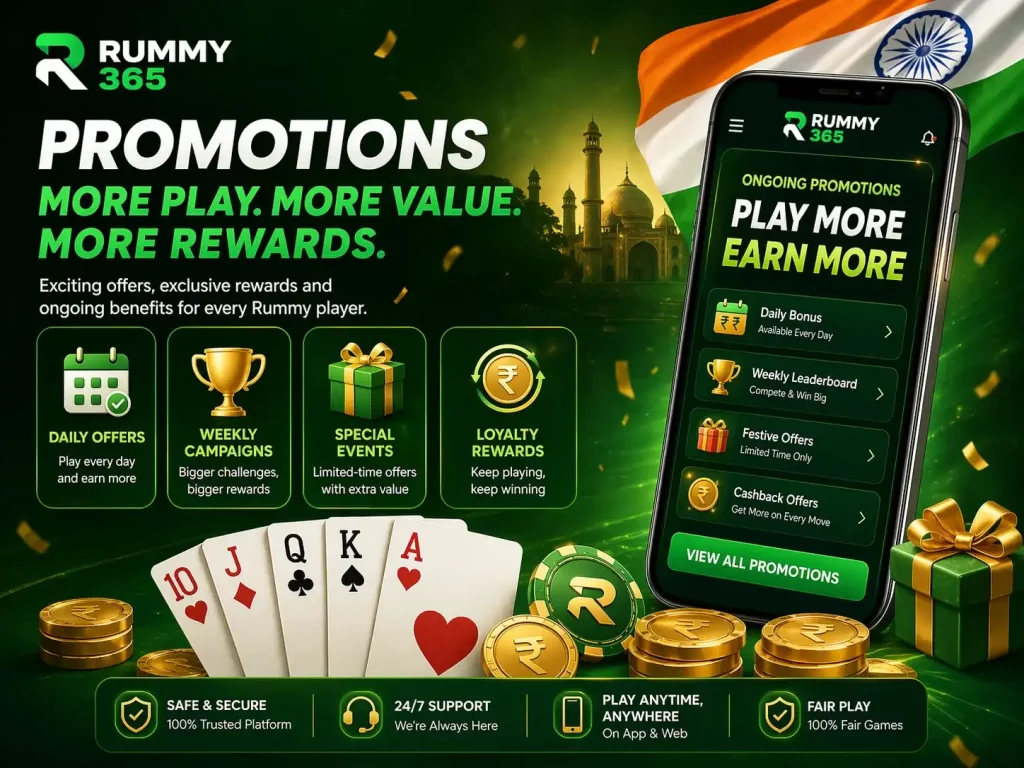
A key aspect of promotions on Rummy 365 is accessibility. Offers are typically designed so that users can understand them quickly and participate without unnecessary complexity. This is particularly important for Indian rummy audiences, where clarity often matters as much as the value itself. Promotions should feel like a natural extension of gameplay rather than a separate system that requires extra effort to understand.
Another important factor is timing. Promotions are often tied to specific moments such as daily activity, weekly cycles, or special events. This creates a rhythm that encourages consistent interaction. Instead of relying on a single large incentive, the platform distributes value across multiple smaller opportunities. From a user perspective, this approach feels more balanced and sustainable.
| Promotion Type | Activation Timing | User Interaction | Expected Benefit |
|---|---|---|---|
| Daily Offers | Every day | Regular play sessions | Consistent value flow |
| Weekly Campaigns | Fixed weekly cycle | Repeated engagement | Higher cumulative value |
| Event-Based Promotions | Limited-time periods | Focused participation | Short-term boosts |
| Seasonal Rewards | Special occasions | Optional engagement | Enhanced experience |
This table highlights how promotions are distributed across time rather than concentrated in one place. Each type serves a different purpose, but together they create a consistent flow of opportunities. For SEO content, this is valuable because it helps users understand not just what promotions exist, but how they fit into their overall experience.
Another way to interpret promotions is through user participation patterns. Not every player interacts with promotions in the same way. Some engage daily, others focus on weekly campaigns, and some only participate during special events. This variation is important because it shows that promotions are flexible rather than restrictive.
The distribution above shows that no single type of promotion dominates user behaviour completely. Instead, engagement is spread across different formats. This reinforces the idea that a diverse promotional structure is more effective than a one-dimensional approach.
Another important point is how promotions interact with platform features. They are not isolated elements, but part of a broader system that includes gameplay, rewards, and accessibility. For example, some users may access promotions directly through the app, while others may encounter them during regular gameplay sessions. This integration ensures that promotions feel natural rather than intrusive.
| Access Method | User Behaviour | Interaction Frequency | Experience Impact |
|---|---|---|---|
| Dashboard Access | Direct navigation | Moderate | Clear overview |
| In-Game Visibility | Context-based discovery | High | Seamless interaction |
This comparison highlights how accessibility affects engagement. Promotions that are easy to find and activate naturally see higher interaction levels. This is not just a design principle, but also an important SEO insight, because users often look for platforms where offers are easy to understand and use.
To complete this section, it is useful to look at how perceived value changes depending on the structure of promotions. This helps explain why some promotional systems feel more rewarding even when the numerical value is similar.
This chart reinforces the idea that promotions are evaluated on multiple levels. Value size is important, but how often and how easily that value can be accessed plays an equally significant role.
At this point, the Promotions page begins to form a clear structure. Instead of focusing on individual offers, it explains the entire promotional ecosystem of Rummy 365. This makes the content more useful, more informative, and more aligned with real user expectations.
Promotion Mechanics and Player Interaction Patterns
After understanding the general structure of promotions, the next step is to explore how these offers actually function during real usage. On Rummy 365, promotions are not static rewards but interactive systems that respond to player activity. This means that the value of a promotion depends not only on what is offered, but also on how and when users engage with it.
One of the key characteristics of promotion mechanics is conditional activation. Unlike simple rewards, many offers are triggered by specific actions such as participation, session frequency, or progression within the platform. This creates a dynamic relationship between the user and the system. Instead of receiving value passively, players interact with promotions as part of their normal gameplay flow.
This approach helps create a more natural experience. Promotions feel like an extension of gameplay rather than a separate layer. For users, this reduces complexity and makes the system easier to understand. From a content perspective, it is important to explain these mechanics clearly, because they define how useful a promotion actually becomes over time.
| Mechanic Type | Trigger Condition | User Action | System Outcome |
|---|---|---|---|
| Activity-Based | Regular gameplay | Session participation | Value gradually unlocked |
| Milestone-Based | Progress thresholds | Achieving targets | Reward activation |
| Time-Based | Daily or weekly cycle | Timed participation | Recurring rewards |
| Event-Based | Limited-time campaigns | Focused engagement | Short-term value spikes |
The table above shows that promotions rely on different types of triggers. Each mechanic serves a unique purpose, but together they create a flexible system that adapts to different playing styles. This diversity is important because it ensures that promotions remain relevant for both casual and more active users.
Another way to analyze promotion mechanics is through interaction intensity. Not all promotions require the same level of engagement. Some are simple and passive, while others require more consistent participation. This variation creates multiple entry points, allowing users to choose how deeply they want to engage with the system.
This gradual increase in interaction intensity demonstrates how promotions cater to different user preferences. Some players may prefer minimal involvement, while others actively seek out opportunities to maximize value. A well-balanced system accommodates both approaches without forcing a single pattern.
Another important element is how promotions influence session behaviour. While they do not dictate how users play, they often shape how sessions are structured. For example, time-based promotions may encourage shorter but more frequent sessions, while milestone-based offers may lead to longer, goal-oriented play periods. Understanding this connection helps explain why promotions are designed in specific ways.
| Promotion Type | Session Style | User Behaviour | Experience Effect |
|---|---|---|---|
| Daily Offers | Short sessions | Frequent logins | Consistency |
| Milestone Campaigns | Long sessions | Goal-oriented play | Focused engagement |
| Event Promotions | Variable | Adaptive participation | Flexible interaction |
This comparison highlights how promotions subtly shape user behaviour without restricting it. The flexibility of the system ensures that players can interact with promotions in a way that matches their preferences.
To complete this section, it is useful to look at how different mechanics contribute to overall promotion effectiveness. This provides a clearer picture of why certain structures perform better than others.
This chart reinforces a consistent theme across the page: promotions are most effective when they balance clarity, accessibility, and flexibility. High-value offers alone are not enough. The way those offers are structured and delivered plays an equally important role.
By this point, the Promotions page moves beyond basic definitions and begins to explain how the system actually works in practice. This deeper understanding prepares the reader for the next section, where the focus will shift toward long-term value patterns and how promotions evolve across extended platform use.
Long-Term Promotion Value and Evolution Over Time
When looking beyond individual campaigns, promotions on Rummy 365 start to form a long-term value system rather than a set of isolated offers. This is where the real depth of the platform becomes visible. Instead of focusing only on immediate rewards, promotions gradually build a layered experience that evolves alongside user activity. For many players, this progression is more important than any single offer because it defines how the platform feels over weeks and months of use.
One of the key principles behind long-term promotions is continuity. Rather than creating gaps between campaigns, the system ensures that there is always some form of available value. This does not mean that every moment is filled with high-impact rewards, but it does mean that users rarely experience a complete absence of opportunity. From a behavioural perspective, this creates a sense of stability. Players begin to understand that value is not tied to a single moment, but distributed across time.
Another important concept is accumulation. Promotions often work together rather than separately. A daily offer may overlap with a weekly campaign, while a seasonal event may enhance both. This layering effect creates a more complex system, but when explained properly, it becomes easier to understand. For SEO content, this is a critical point because it shows users that the platform offers more than isolated incentives. It offers a continuous flow of interaction opportunities.
| Time Frame | Promotion Layer | User Interaction | Value Impact |
|---|---|---|---|
| Daily | Short-cycle offers | Frequent participation | Stable base value |
| Weekly | Mid-cycle campaigns | Repeated engagement | Accumulated benefit |
| Monthly | Extended campaigns | Strategic play | Higher overall return |
| Seasonal | Special events | Focused bursts | Peak engagement |
The structure above shows how promotions scale over time. Short-term offers provide consistency, while longer campaigns create depth. Together, they form a system where value is layered rather than concentrated. This layered structure is one of the main reasons why long-term engagement feels more balanced.
Another key element is how users adapt to this system. At the beginning, players often focus on individual promotions. Over time, however, they start to recognize patterns. They understand when certain offers appear, how they overlap, and how to interact with them more efficiently. This shift from reactive behaviour to structured understanding is what defines long-term interaction.
To better visualize how value accumulates across different time frames, it is useful to look at a progressive curve. This helps illustrate why long-term promotion systems often feel more rewarding than short-term ones.
The curve above reflects a gradual increase rather than sudden spikes. This is a defining characteristic of well-structured promotion systems. Instead of delivering all value at once, they spread it across time, making the experience feel more sustainable.
Another perspective to consider is how different types of users interact with long-term promotions. Not all players aim for maximum accumulation. Some prefer steady interaction, while others engage more selectively. This diversity is important because it shows that the system does not rely on a single behavioural model.
| User Type | Approach | Promotion Interaction | Long-Term Outcome |
|---|---|---|---|
| Consistent Player | Regular sessions | Continuous participation | Stable accumulation |
| Selective Player | Event-focused | Targeted engagement | High-value bursts |
| Casual Player | Irregular activity | Occasional interaction | Moderate benefit |
This comparison highlights how flexibility remains a central strength of the promotion system. Users are not forced into a specific pattern. Instead, they can adapt their interaction based on their own preferences and available time.
Finally, it is useful to look at how different promotion layers contribute to overall value perception. This helps explain why long-term systems often feel more rewarding even when individual offers are not exceptionally large.
This final visualization shows that value is distributed across multiple layers rather than dominated by a single type of promotion. This balance is what makes the system feel consistent over time.
At this stage, the Promotions page provides a complete understanding of how value evolves on Rummy 365. It moves from simple definitions to a deeper explanation of long-term interaction, giving users a clear picture of how promotions function as an ongoing system rather than isolated events.
Promotions as a Continuous Value System
At this stage, promotions on Rummy 365 can be clearly understood not as isolated offers, but as a continuous system that evolves with user interaction. From daily incentives to long-term accumulation patterns, every element contributes to a broader structure where value is distributed over time. This final section brings everything together, showing how different mechanics, timelines, and user behaviours combine into a single, consistent experience.
One of the most important conclusions is that promotions operate as a cycle rather than a straight line. A player does not simply move from one offer to another. Instead, they enter a loop where value is introduced, used, and then renewed through new opportunities. This cycle is what keeps the system dynamic without relying on constant high-impact events. It creates a rhythm that users can understand and adapt to over time.
Another key point is balance. Promotions are designed to maintain equilibrium between accessibility and depth. If the system focuses only on simplicity, it may feel limited. If it becomes too complex, it may feel overwhelming. The structure on Rummy 365 sits between these extremes, allowing both casual and more engaged users to find a comfortable way to interact with ongoing offers.
| System Element | Function | User Interaction | Long-Term Effect |
|---|---|---|---|
| Recurring Offers | Provide stability | Frequent participation | Consistent engagement |
| Campaign Events | Introduce variation | Focused activity | Increased interest |
| Progressive Systems | Build value over time | Ongoing interaction | Accumulated benefits |
| Flexible Access | Allow different entry points | Adaptive behaviour | User comfort |
The table above summarizes how each part of the promotional system contributes to the overall experience. Rather than focusing on a single factor, it shows how different elements interact to create a balanced structure. This multi-layered approach is what makes the system sustainable over time.
Another important perspective is how users gradually shift their understanding of promotions. At the beginning, attention is focused on individual offers. Over time, players begin to see patterns, cycles, and relationships between different promotions. This shift is significant because it transforms the experience from reactive to strategic. Users no longer simply respond to offers; they anticipate them.
To better illustrate how this transformation happens, it is useful to look at a full-cycle engagement model.
This cycle demonstrates how engagement evolves rather than resets. Each stage builds on the previous one, creating a continuous loop of interaction. This is one of the defining characteristics of a well-structured promotion system.
Another useful way to conclude this page is to compare how different elements contribute to overall satisfaction. This helps highlight the balance between structure, flexibility, and accessibility.
| Factor | Role | Impact Level | User Perception |
|---|---|---|---|
| Consistency | Maintains value flow | High | Reliability |
| Variety | Prevents repetition | Medium | Interest |
| Flexibility | Supports different styles | High | Comfort |
| Accessibility | Simplifies interaction | High | Ease of use |
At this point, the Promotions page provides a complete and structured understanding of how the system works. It moves from basic definitions to advanced insights, covering mechanics, behaviour patterns, long-term value, and overall structure. This depth is what makes the content both SEO-effective and genuinely useful for users.
The key takeaway is simple: promotions on Rummy 365 are not just rewards. They are a system that evolves with user interaction, providing value across different stages and adapting to different playing styles. When understood as a whole, this system becomes much easier to navigate and much more meaningful in practice.
To conclude the Promotions page in a stronger and more complete way, it is worth reinforcing one final idea: the true value of promotions on Rummy 365 is not defined by individual offers, but by how all elements work together over time. When users first arrive, they may focus on visible incentives. However, as interaction continues, the system reveals a deeper structure where consistency, timing, and flexibility play a much larger role.
This layered approach creates an environment where value is not limited to specific moments. Instead, it becomes part of the overall platform rhythm. Players gradually move from simple participation to a more structured understanding of how and when to engage with different promotional opportunities. This transition is what makes the experience feel more complete and less dependent on short-term incentives.
Another important aspect is predictability without repetition. Promotions follow recognizable patterns, but they do not become monotonous. This balance allows users to anticipate opportunities while still experiencing variation. From a usability perspective, this reduces uncertainty while maintaining interest. From an SEO perspective, it ensures that the page reflects real user expectations rather than abstract descriptions.
Over time, users begin to recognize how different promotion types complement each other. Daily offers provide stability, weekly campaigns add structure, and event-based promotions introduce variation. When combined, these layers create a system that feels both reliable and dynamic. This is particularly important for platforms like Rummy 365, where user interaction is ongoing rather than occasional.
It is also worth noting that promotions are not only about increasing activity, but about shaping the overall experience. They influence how users explore the platform, how they structure their sessions, and how they perceive long-term value. A well-balanced system supports these processes without overwhelming the user, making interaction feel natural rather than forced.
From a broader perspective, the Promotions system reflects how the platform approaches user engagement as a whole. Instead of relying on one-time incentives, it builds a framework where value is continuously refreshed. This creates a smoother transition between different stages of interaction, allowing users to move forward without friction.
In practical terms, this means that users are not required to constantly search for new opportunities. The system itself provides a steady flow of options, making it easier to stay engaged without additional effort. This simplicity is one of the key strengths of a well-designed promotion structure.
As a final takeaway, the Promotions page should leave the reader with a clear understanding that value on Rummy 365 is not static. It evolves with time, adapts to different behaviours, and remains accessible across different levels of interaction. This combination of consistency and flexibility is what defines a strong promotional system.
By bringing together all these elements, the page achieves its main goal: not just to describe promotions, but to explain how they function as a complete and structured part of the platform experience.






Comments